Home / Destinations / Canada
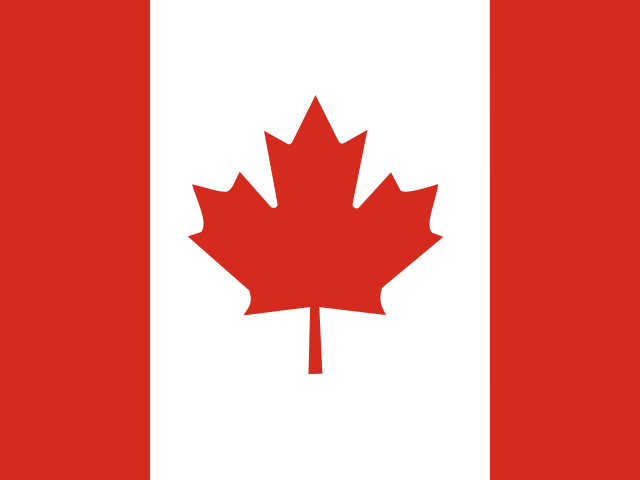 Study in Canada from Bangladesh
Post-study work permit, clear route to residency
Talk to a counsellor - freeIn short
Studying in Canada from Bangladesh typically costs CAD 15,000–CAD 35,000 a year in tuition plus living costs. You apply for a study permit after an offer, and must show proof of funds beyond tuition. A Post-Graduation Work Permit of up to three years follows an eligible programme, and that work experience counts towards permanent residency.
Tuition
CAD 15,000–CAD 35,000 per year for most undergraduate and Master's programmes
Living costs
CAD 12,000-CAD 20,000 per year in real spending, with Toronto and Vancouver well above smaller provinces. Separately, IRCC requires a single applicant outside Quebec to show CAD 22,895 for living costs on top of first-year tuition and travel. Quebec sets its own higher figure, and IRCC re-indexes the amount annually - check canada.ca before you apply.
Intakes
Fall (September, the main one), Winter (January), Summer (May) at some institutions
After graduating
Post-Graduation Work Permit - 8 months to 3 years, tied to the length of your programme and, for some, the field of study
Why Bangladeshi students choose Canada
Canada is chosen less for the degree itself than for what comes after it. The Post-Graduation Work Permit, and the way Canadian work experience feeds into the Express Entry points system, make it the clearest study-to-settlement path among the major destinations. Rules here change more often than elsewhere, so current official guidance matters more than a consultancy blog from last year.
- ›Post-Graduation Work Permit of up to three years, depending on programme length
- ›Canadian work experience counts towards permanent residency through Express Entry
- ›Tuition is generally lower than comparable universities in the USA or UK
- ›Spouses of some students can apply for an open work permit
Cost of studying in Canada
| Tuition | CAD 15,000–CAD 35,000 per year for most undergraduate and Master's programmes |
|---|---|
| Living costs | CAD 12,000-CAD 20,000 per year in real spending, with Toronto and Vancouver well above smaller provinces. Separately, IRCC requires a single applicant outside Quebec to show CAD 22,895 for living costs on top of first-year tuition and travel. Quebec sets its own higher figure, and IRCC re-indexes the amount annually - check canada.ca before you apply. |
| Currency | CAD ($) |
| Work while studying | Up to 24 hours per week off campus during term, full time during scheduled breaks |
Figures are indicative and move with exchange rates and policy. Confirm current amounts on Government of Canada - Study permits before you budget or transfer funds.
Entry requirements
Academic
HSC for undergraduate, a Bachelor's for Master's. Institutions look closely at the gap between your last qualification and the application.
English language
IELTS 6.0–6.5 is the usual requirement; many institutions also accept PTE, TOEFL or the Duolingo English Test.
No IELTS score yet? There are recognised alternatives - see which ones count, and where they don't.
Study permit: step by step
- 1 Receive a Letter of Acceptance from a Designated Learning Institution
- 2 Obtain a Provincial Attestation Letter where your province and programme require one
- 3 Show proof of funds covering tuition plus living costs, commonly through a GIC
- 4 Complete the online study permit application and pay the fee
- 5 Give biometrics and complete the required medical examination
Official guidance: Government of Canada - Study permits
Hoping to bring your husband or wife with you? Dependant rules differ by country, by course level and by year, so this is worth checking before you apply rather than after. See our spouse & dependant visa support.
Scholarships
- ›Vanier Canada Graduate Scholarships - doctoral level, highly competitive
- ›Institution-specific entrance scholarships, often awarded automatically
- ›Provincial and departmental awards, particularly at Master's level
Universities we work with in Canada
Frequently asked questions
How much does it cost to study in Canada from Bangladesh?
Tuition usually runs CAD 15,000–CAD 35,000 a year and living costs CAD 12,000–CAD 20,000, depending heavily on the city. Toronto and Vancouver sit well above the national average, and choosing a smaller province is one of the few decisions that meaningfully changes the total.
How much proof of funds is needed for a Canadian study permit?
You must show tuition plus living costs for yourself and any accompanying family. The living-cost threshold is set by IRCC and has been revised upward more than once in recent years, so check the current figure on the IRCC site rather than relying on an older number. Many students meet the requirement through a Guaranteed Investment Certificate.
Can I work while studying in Canada?
Eligible students can work up to 24 hours a week off campus during term and full time during scheduled breaks. This limit has changed more than once recently, so confirm the current rule before you count on a particular number of hours.
Does studying in Canada lead to permanent residency?
It is a recognised route rather than a guarantee. A Canadian credential and skilled Canadian work experience both earn points under Express Entry, which is why the Post-Graduation Work Permit matters so much. Selection thresholds move with each draw, so nobody can promise an outcome.
What is a Provincial Attestation Letter?
It is a letter from the province confirming your place counts against its allocation of study permit applications. Most new applicants need one, with some exemptions. Your institution normally arranges it, but it is worth confirming early because an application without one where it is required will be returned.